 PPC’s Spring Folding Carton Boot Camp recently welcomed another outstanding group of attendees to Springfield, Massachusetts, for two days of hands-on education designed to strengthen technical knowledge across the full paperboard packaging lifecycle.
What continues to make Boot Camp so valuable is the range of professionals it brings together. Some attendees are brand-new to the industry, while others have spent years in paperboard packaging and are looking to deepen their technical understanding, take on new responsibilities, or refresh their knowledge of the manufacturing process. Regardless of experience level, Boot Camp is designed to help see the bigger picture of how every stage of paperboard packaging connects: from fiber sourcing to the finished carton on the shelf.
Throughout the program, attendees explored the full journey of folding carton manufacturing through presentations led by industry experts representing every stage of production, design, converting, and finishing.
Starting at the Source: Fiber, Forestry, and Paperboard Fundamentals

Boot Camp began where every carton begins: with fiber.
Steve Rote of Metsä Board Americas Corporation opened the program with an in-depth look at virgin paperboard production, walking attendees through sustainable forestry practices, pulping methods, papermaking, coating, calendaring, and board performance. His session helped attendees better understand how factors like fiber selection, grain direction, moisture control, and board construction directly influence printability, stiffness, runnability, and overall package performance.
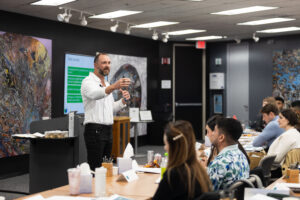 Quinn Garber of Integrity Fiber then shifted the conversation toward recovered fiber and the critical role recycling continues to play within the circular economy. Attendees gained insight into how recovered materials are sourced, processed, and reintroduced into the manufacturing stream, reinforcing the deep connection between sustainability and operational efficiency throughout the industry.
Building on those conversations, Roberto Balaguer of Smurfit Westrock focused specifically on recycled paperboard and the evolving role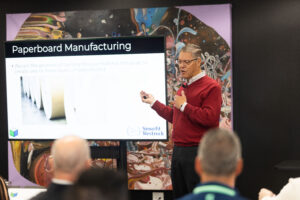 recycled materials continue to play across the paperboard packaging landscape. His presentation helped attendees better understand recycled fiber applications, sustainability considerations, and the performance characteristics manufacturers must evaluate when selecting materials.
As the program transitioned further into manufacturing operations, Ben Markens, former President of PPC, guided attendees through foundational production concepts, including web-fed versus sheet-fed production, grain direction, carton measurement conventions, and key manufacturing terminology that influences efficiency across the production floor.
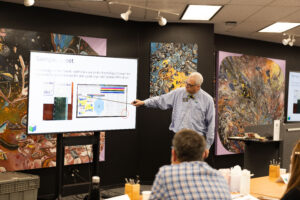 Attendees then explored sheeting and rewinding operations, gaining insight into how splicers, decurlers, tension control systems, rotary cutters, and stackers work together to create consistent, press-ready sheets while minimizing curl and reducing downstream production issues.
Together, these early sessions established a strong technical foundation for understanding how decisions made at the material and production stages ultimately influence every part of the finished package.
Bridging Creativity and Manufacturing
As Boot Camp moved into design and print production, attendees explored how creativity and manufacturing work hand in hand to create effective packaging.
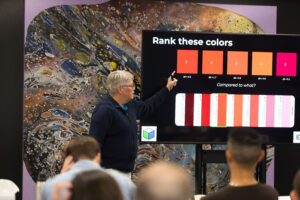 Susie Stitzel of Esko guided attendees through structural design principles and color theory, helping bridge the gap between creative packaging concepts and real-world production realities. Her presentation highlighted how thoughtful design decisions impact everything from visual appeal to manufacturing consistency.
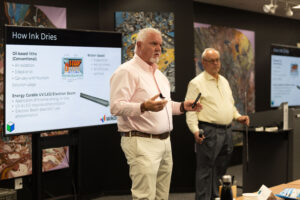 Gene Cowden and Chris Blackburn of Wikoff Color Corporation followed with a deep dive into inks and coatings, exploring how print chemistry, curing methods, coatings, and finishing processes influence package durability, appearance, and production performance.
Eric Frank of Koenig & Bauer led multiple sessions throughout Boot Camp focused on printing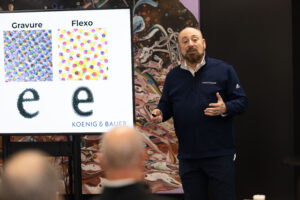 processes, cold foil applications, and rotary diecutting technologies. His presentations gave attendees a deeper understanding of how printing technologies continue to evolve to support greater efficiency, premium embellishments, and increasingly sophisticated packaging effects that help brands stand out on the shelf.
 Harold Leete of BOBST expanded on those themes through several highly technical sessions covering digital printing, litho laminating, and sheetfed diecutting, blanking, and embossing operations. His presentations showcased how modern converting technologies are evolving to support shorter runs, faster makereadies, improved production flexibility, and enhanced finishing capabilities. Attendees also gained valuable insight into how embossing, laminating, and die-cutting contribute not only to package functionality but also to the carton’s overall visual and tactile experience.
Roy Oomen of Agfa Corp. introduced attendees to digital diecutting technologies and the growing opportunities digital advancements are creating for prototyping, shorter production runs, customization, and packaging innovation.
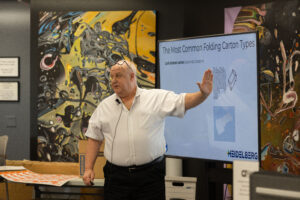 Chris Rainey of Heidelberg USA, Inc. then guided attendees through folding carton styles and folder-gluer operations, helping attendees better understand the differences between straight-line, lock-bottom, partition, 4-corner, and 6-corner cartons, as well as the operational workflow required to efficiently fold, glue, compress, eject, and package finished cartons. His sessions also explored the relationship between carton structure, grain direction, gluing systems, and overall production performance.
Throughout each presentation, attendees were reminded that successful packaging is never the result of a single process. It requires collaboration between materials, design, printing, converting, and manufacturing teams, all working together toward a shared outcome.
From Converting Operations to Consumer Experience
As the program continued, attendees took a deeper dive into the converting and finishing operations that ultimately bring cartons to life.
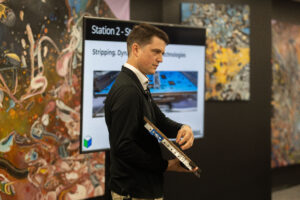 Miles Guessford of Marbach explored converting tools and their role in increasing quality, stripping, ejection, and overall production performance. His session highlighted how precision tooling directly affects manufacturing consistency and carton quality.
Gayle Harrop of Tamarack Products Inc. walked attendees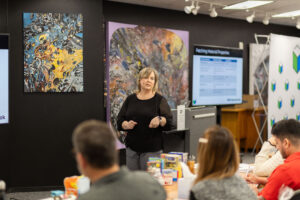 through carton windowing processes and key operational considerations. At the same time, Kirsty Drury of Henkel explored gluing fundamentals, adhesives, substrate compatibility, and how bonding performance impacts both package
 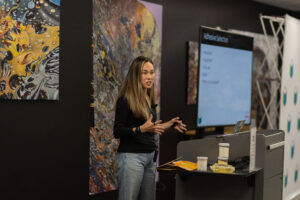 integrity and production efficiency.
Ben Markens returned to lead additional sessions focused on automatic packaging systems, air-hammer stripping, and rigid box packaging, exposing attendees to the broader range of packaging applications and production systems used throughout the paperboard packaging industry. His rigid box presentation explored luxury packaging construction, embellishments, specialty finishes, and the growing role packaging plays in shaping premium brand experiences and consumer perception.
Together, these sessions reinforced an important takeaway from Boot Camp: every production decision contributes to the final consumer experience, from structural integrity and functionality to visual appeal and shelf impact.
Learning That Extends Beyond the Classroom
One of the most valuable aspects of PPC’s Folding Carton Boot Camp is its ability to make highly technical concepts approachable and immediately applicable. 
Attendees are not simply learning isolated manufacturing processes. They are learning how every stage of production connects and how decisions made upstream can directly impact efficiency, quality, sustainability, and customer experience downstream.
Beyond the technical education itself, Boot Camp also creates opportunities for attendees to connect with peers, ask questions directly to industry experts, and strengthen relationships across the paperboard packaging supply chain.
“I would like to express my appreciation for the opportunity to attend PPC’s Folding Carton Boot Camp training,” shared Greg Bartolin, Quality Coordinator at Tavo Packaging. “I truly enjoyed the experience and gained valuable knowledge that I was able to bring back to my facility.
“Since returning, I have been recommending this Boot Camp to all associates because of the insight, hands-on learning, and overall value the training provided. I am grateful for the opportunity to attend.”
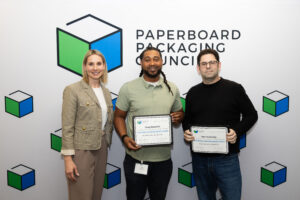
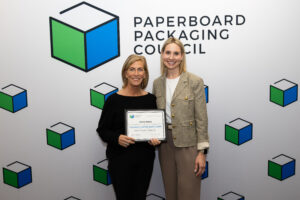 This year’s Boot Camp also welcomed PPC’s 2026 Woods Scholar, Karla Ness, Customer Service Manager at Mill Rock Packaging. The Woods Scholar Award is presented annually to a passionate and enthusiastic rising star within the folding carton industry. As part of the award, recipients receive a scholarship to attend PPC’s Folding Carton Boot Camp.
Karla’s participation in this year’s Boot Camp reflects the spirit of curiosity, growth, and industry engagement that the Woods Scholar Award was designed to recognize. PPC congratulates Karla on this well-deserved achievement and looks forward to her continued contributions to the industry.
This kind of feedback and engagement reflects exactly what PPC’s Folding Carton Boot Camp is designed to do: provide education that strengthens individuals, member companies, and ultimately strengthens the broader paperboard packaging industry.
PPC extends sincere thanks to all instructors and attendees who helped make this year’s Spring Folding Carton Boot Camp another success.
Thank You to Our Sponsors
PPC extends sincere thanks to the sponsors who helped make this Boot Camp possible, including Diamond sponsor Koenig & Bauer; Sapphire sponsors Metsä Board Americas, Smurfit Westrock, and Clearwater Paper; and Platinum sponsors BOBST, CMPC Forest Products NA, eProductivity Software, and Sappi for their support of this program and the learning experience it delivers.
Looking Ahead: Fall 2026 Boot Camp
With the Fall 2026 Boot Camp already scheduled for November, PPC remains committed to driving innovation, sustainability, and professional growth for our members and the broader paperboard packaging industry.