Unity & Collaboration: A Conference of Industry Insight, Leadership, and Shared Purpose
 Vancouver greeted the PPC community with a spirit that was fitting for this moment in time, one defined by collaboration, continuity, and the collective strength of an industry that succeeds when it moves forward together.
With the rising economic complexity and technology reshaping entire business models, the 2025 Fall Meeting & Leadership Conference became more than just a gathering. It became a statement of unity, an affirmation that PPC members thrive because they lead, adapt, and face change as a community.
A Leadership Team Charting the Path Forward
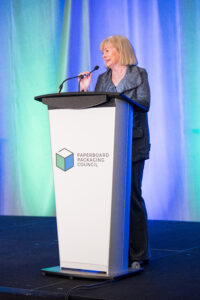
The morning began with remarks from PPC Board Chair Hilda Murray, stepping onto the stage for the first time in her new role. With both clarity and conviction, she acknowledged the significance of this year, one in which leadership is transitioning not just at PPC, but across many member companies, as they navigate generational succession. Her message was steady and straightforward: “We succeed when we move forward together.”
Beside her stood PPC’s VP & Executive Director Emily Leonczyk, whose leadership, now entering its next chapter, continues to redefine PPC through modernization, member-driven programming, and a reinvigorated strategic direction. Emily spoke candidly about the work ahead: strengthening PPC’s advocacy voice and ensuring that PPC remains “the table where folding carton leaders solve problems together.”
Finally, PPC President Ben Markens offered his signature blend of pragmatism and perspective, reminding the room that unity within PPC has always been rooted in shared values, education, stewardship, and the consistent belief that collaboration is the foundation of industry progress. “Transitions are not headwinds,” he noted. “They’re simply the next step in a long arc of growth.”
Together, the three leaders set the tone for the day: confident, steady, and forward-looking; a united front guiding an industry in motion.
A Message from Koenig & Bauer: Leading with Presence and Purpose
Eric Frank, SVP of Marketing & Product Management at our Diamond Sponsor, Koenig & Bauer US/CA, delivered a candid reminder that in uncertain times, leadership is less about strategy and more about presence. Drawing on real-world experiences, Frank illustrated how meaningful connections happen when leaders step out from behind their desks and engage face-to-face.

Frank emphasized that today’s environment, defined by what he called FUD: fear, uncertainty, and doubt, requires leaders to be intentional about the tone they set. Employees don’t just hear words; they read posture, expression, and energy. A single reaction can unite a room or tear it apart. He urged leaders to avoid “energy vampires” who drain team momentum, and instead model steadiness, authenticity, and optimism.
When leaders consistently show up and stand behind their people, unity naturally follows. The charge he left the room with echoed throughout the day: in moments that matter, seize the opportunity to lead with clarity, confidence, and connection.
A CEO’s Perspective on a New Global Giant
Few moments captured the theme of transition more clearly than the CEO keynote from Laurent Sellier of Smurfit Westrock North America, speaking in his first year at the helm of the newly merged global entity.

Sellier delivered the message the industry has been waiting for: clarity on how the combined company intends to operate, invest, and lead. With characteristic transparency and a calm, operational focus, he explained that Smurfit Westrock is positioning itself not as the largest packaging company in the world, but as the most resilient, agile, and globally integrated.
“We are not building a giant for the sake of size,” Sellier told attendees. “We are building a company prepared for the future—one connected from region to region, combining the best of both legacies into something stronger than either could be alone.”
He emphasized the necessity of global connectivity, responsible growth, and long-term investment, particularly at a time when customers expect both innovation and consistency. His keynote grounded the meeting’s early hours with a real-world example of transition done with vision and purpose.
Environmental & Market Intelligence: A Morning of Expertise
Charting the Environmental Landscape
Rachel Kagan, Executive Director of the Paper & Paperboard Packaging Environmental Council (PPEC), brought a Canadian perspective to the room, one that continues to accelerate regulatory influence across North America. Her briefing highlighted the ongoing shifts in extended producer responsibility, recycled-content mandates, and the development of carbon-focused policies.
Kagan emphasized that packaging policy is no longer evolving; it is accelerating, and she challenged companies to work proactively rather than defensively. Her message resonated clearly: prepare early, engage often, and never underestimate the speed at which environmental expectations are shifting.
Europe’s Market and Regulatory Pulse
From across the Atlantic, Mike Turner, Managing Director of the European Carton Makers Association (ECMA), delivered one of the most globally contextualized updates of the day. With wit, honesty, and sharp industry insight, Turner explained the political and regulatory climates shaping Europe’s folding carton markets.

He pointed to both opportunity and caution: the continued expansion of fiber-based packaging demand, balanced against increasingly restrictive policy frameworks. “Europe is not just a preview of what may come,” he warned. “In some cases, it is the testing ground.”
His presentation provided attendees with a clear understanding of why staying informed about European policy is now non-negotiable for North American converters.
Industry Affairs: What PPC Is Watching
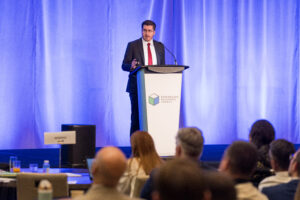
PPC’s own Tom Hendrickson, Manager of Industry Affairs, provided a structured view of the advocacy landscape PPC is navigating on behalf of members. His update, grounded in fact rather than conjecture, highlighted state-level legislation, federal regulatory momentum, and the areas where PPC is actively representing the interests of converters.
Tom’s work reinforced PPC’s commitment to being the authoritative, collective voice for folding cartons, particularly at a time when legislation and regulation increasingly shape business planning.
Do you have questions regarding EPR, packaging policy legislation, and what it all means for your business? Reach out to Tom at tom@paperbox.org.
Strategic Forces Reshaping Packaging
McKinsey’s David Feber: How to Plan for What Comes Next
In a high-energy, insight-rich presentation, David Feber, Senior Partner of McKinsey & Company, brought a long-view perspective on the industry’s most pressing strategic forces. Feber’s analysis was grounded in data but delivered with accessible clarity, showing members not only what is happening, but what to do next.

He outlined emerging shifts in consumer demand, the realities of cost pressure, and the accelerating role of sustainability and digitalization across value chains. He underscored the ongoing transformation of packaging from a cost center to a strategic growth driver and urged converters to build flexibility into their planning cycles.
Feber’s takeaway was evident: those who prepare for long-term structural change, not just short-term disruption, will lead the next decade of industry growth.
Women’s Leadership Council Luncheon: Communicating with Conviction
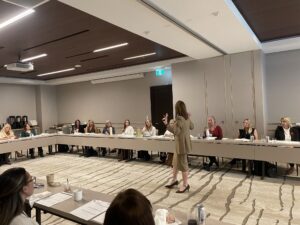
The Women’s Leadership Council (WLC) Luncheon, now in its second decade under the steady guidance of Dr. Ann Bowers-Evangelista, marked its largest gathering of women leaders to date. What began years ago as a small circle of emerging voices has grown into one of PPC’s most energizing and ambitious communities, and this year’s turnout reflected that momentum.
Ann, who has shepherded the WLC since its earliest days, brought her signature blend of psychological insight, executive coaching expertise, and endurance-athlete discipline to a session focused on one of leadership’s most critical challenges: communicating with conviction when it matters most.
She explored why even the most experienced leaders can lose clarity or confidence in high-stakes moments, whether advocating for a new idea, addressing conflict, or influencing a pivotal decision. “Our conviction isn’t about having the right words,” she reminded the room. “It’s about having the presence to deliver them.”
At the center of her workshop was the PACE framework, a practical model designed to strengthen executive presence under pressure. Through interactive exercises, candid reflection, and real-world scenarios, participants examined the communication habits that diminish their impact and practiced techniques that elevate clarity, composure, and authority.
Drawing on her identity as an endurance athlete, Ann connected effective communication to sustainable leadership: “Conviction isn’t a personality trait—it’s a skill. And like any endurance discipline, it grows with deliberate effort.”
Attendees left not only with tools to command the room, but also with renewed confidence, buoyed by the largest community of women leaders the WLC has ever brought together.
Emerging Leaders Session: Managing Up with Confidence and Clarity
The Emerging Leaders cohort gathered for a high-energy afternoon session led by Tiffany Koettel, President & CEO of Growth Mindset Sales, whose 16 years in the paperboard packaging industry and deep expertise in the Sandler Sales System set the tone for a refreshingly candid discussion on navigating hierarchy and driving change from any position.

Framing the conversation around a familiar challenge, Tiffany noted that even the most innovative ideas can stall when they meet entrenched habits or the dreaded “we’ve always done it this way” mindset. Managing up, she emphasized, is both an art and a discipline, one that requires clarity, credibility, and an understanding of what motivates top-level decision-makers.
With her signature blend of storytelling, behavioral insight, and practical application, Tiffany guided participants through real-world examples of how organizational resistance manifests and how emerging leaders can anticipate and overcome it. She challenged the room to think differently about influence, urging them to build trust through curiosity, alignment, and disciplined communication rather than force or frustration.
Through interactive exercises and guided reflection, attendees explored how to reframe ideas in ways that resonate, present innovation through a leadership lens, and move projects forward even within traditional or risk-averse cultures. Tiffany’s emphasis on equal business stature and intentional communication offered a new perspective on advocating for change while maintaining strong relationships with senior leadership.
Participants left with a clearer roadmap for navigating upward, reducing friction, and building momentum, armed with tools grounded not just in theory but in the practical realities of working within the packaging industry. Tiffany’s message resonated deeply: influence isn’t granted by title, but earned through preparation, empathy, and the courage to communicate with purpose.
Member Spotlight: Great Little Box Company
Culture as Strategy, People as Purpose
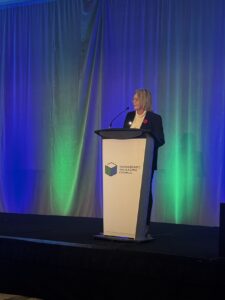
Among the day’s most memorable moments was the Member Spotlight from Doree Quayle, Division President at Great Little Box Company. Standing before peers, many of whom would tour the company’s facility the next morning, Quayle shared the story not of machines or buildings, but of people.
She began by telling the origin of the company name, which was rooted in a decades-old Yellow Pages advertisement that the founders couldn’t afford to change in 1982. It was a charming reminder that great companies are often built first on grit, not grandeur. But the heart of her message was this: “Grow our people, grow our business, and care for our community.”
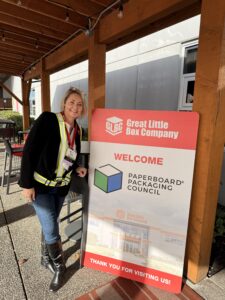
Quayle described a culture of remarkable depth, one defined by transparency, safety, employee development, celebration, and genuine care. Flags representing more than 40 nationalities hang proudly in their facilities. Annual traditions, town halls, employee-driven profit sharing, and deeply personalized recognition programs form a foundation unlike anything else in the industry.
“This is the soul of Great Little Box,” she said. “Culture is not meant to be a mission statement. It’s a commitment to how people show up when no one is watching.”
Her words became one of the day’s most profound reflections on unity through transition: culture is the only strategy that endures.
Working on the Business: Protecting While You Grow
In a session that blended legal insight with practical leadership, Chris Santomassimo, Attorney-at-Law, of OGC Solutions, challenged members to think differently about risk, not as something to fear, but as something to understand, evaluate, and use as a strategic advantage.
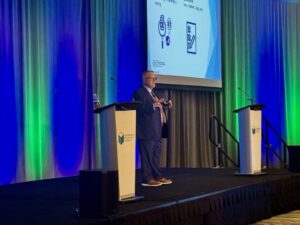
Santomassimo walked through the realities that companies face daily, including customer contracts, vendor agreements, employment complexities, cybersecurity, AI policies, succession planning, and other key issues. With humor, candor, and deep experience as outside general counsel for manufacturers across the country, he emphasized a message that resonated with every leader in the room: “You can’t fix what you don’t understand. Risk isn’t the enemy; being unprepared is.”
He urged companies to establish structured processes, foster accountability, and avoid being paralyzed by uncertainty. In a year of transition across PPC member companies, his presentation was both timely and grounded.
Economic Outlook: Jeff Rosensweig’s Annual Deep Dive
A Changing Global Landscape
Jeff Rosensweig, Director of the John Robson Program for Business, Public Policy, and Government at Emory University, returned to the stage with his unmistakable blend of insight, wit, and global perspective, offering a clear-eyed look at the forces reshaping the economic horizon. His analysis painted a picture of an economy in transition: dynamic, uncertain, and defined by pressures that demand strategic foresight from business leaders.
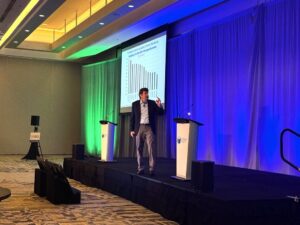
At the center of his presentation was the scale and speed of transformation. Artificial intelligence, he noted, is no longer an emerging disruptor; it’s a gravitational force. By comparing the market capitalization of AI-driven companies to the GDP of entire countries, Rosensweig underscored how profoundly technology has reordered global value creation. Innovation is accelerating, but so are the risks.
Energy, too, is undergoing a tectonic shift. The fracking revolution has fundamentally altered America’s position in the global energy hierarchy. What was once a liability, dependence on foreign oil, has become a strategic advantage as the U.S. moves toward surplus production. This new reality is reshaping trade patterns, geopolitical influence, and long-term supply-chain planning.
Tariffs, he cautioned, are also playing an increasingly prominent role in inflation. While designed to protect domestic industries, these policy decisions ripple outward, elevating consumer costs, altering purchasing behavior, and complicating sourcing strategies for manufacturers.
Rosensweig emphasized that debt levels, both national and consumer, are nearing structural thresholds that could constrain future growth. Combined with demographic shifts and persistent labor shortages, businesses must prepare for a market in which talent is scarce, wage pressure continues, and middle-class households face mounting financial strain.
Taken together, these factors contribute to an increased risk of recession. Not an inevitability, he stressed, but a possibility leaders must be ready to navigate.
Still, Rosensweig’s message was not one of doom. His call to action was grounded in confidence:
“We are transitioning into a different kind of economy. Plan for slower growth. Plan for turbulence. But remember—productivity and resilience are still American strengths.”
Closing the Day: Unity Through Transition
As the day of thought-provoking presentations came to a close, the themes that defined the morning leadership remarks echoed through every session:
Unity. Preparedness. Leadership. Resilience through change.
From the CEO of one of the world’s largest packaging companies to the cultural heartbeat of Great Little Box, from economic realities to strategic risk management, the 2025 Fall Meeting reinforced that the future of folding cartons will not be shaped by a single force, but by a united community of companies ready to face transition together.
PPC remains the place where that unity is built.
Where leadership grows.
Where insight turns into action.
And where the folding carton industry prepares, collectively, for whatever comes next.
This is PPC. This is unity through transition. And this is how industries move forward: together.
Student Design Challenge: A New Generation Elevates Pet Care Packaging
The energy shifted on Wednesday evening as the ballroom filled for one of the most anticipated moments of the conference, the Student Design Challenge Awards, where the next generation of packaging talent took center stage. This year’s brief, which involved developing fully recyclable paperboard packaging for a fictional line of pet care products, including at least one DNA test or lab-dependent item, pushed students into uncharted territory. The complexity of the assignment was evident, yet the clarity and professionalism of the student presentations stunned even the most seasoned attendees.
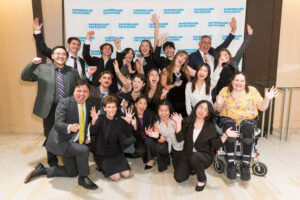
Teams from across North America delivered solutions that were not only technically sound but also strategically and emotionally compelling. Their stage presence mirrored that of industry professionals: articulate, confident, and deeply thoughtful about sustainability. Faculty advisors, many of whom have shaped packaging education for decades, beamed from their seats as their students showcased what the future of this industry looks like.
The judges awarded first place to the Rochester Institute of Technology (RIT) for “Protection, Prevention & Awareness for Pets,” a cohesive system that blended consumer education with structural ingenuity. California Polytechnic State University captured both second and third place with PAWSH and Teef Story, demonstrating Cal Poly’s continued dominance in paperboard innovation and its reputation for design excellence.
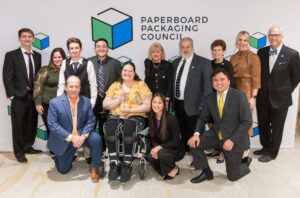
Honorable mentions celebrated standout entries from Cal Poly, Millersville University, Michigan State University, Pennsylvania College of Art & Design, Rochester Institute of Technology, and Toronto Metropolitan University, each bringing its own creative take on the pet care category. And this year’s People’s Choice Award, voted on by the full PPC audience, went to Cal Poly’s PAWSH, highlighting the strong connection between student work and industry expectations.
The evening closed with a celebration of their accomplishments and the announcement of next year’s design challenge, which invites students to imagine a luxury confectionery influencer PR box. This assignment promises even more creativity, storytelling, and experience-driven design.
For many PPC members, the Student Design Challenge is more than an awards program. It is a reminder that the future of folding cartons is not just sustainable, it is bold, curious, and already here.
Celebrating Excellence: Honoring the Year’s Most Exceptional Paperboard Packaging
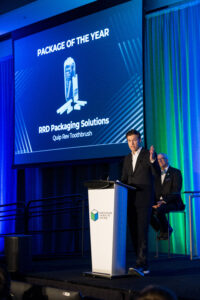
Following the excitement of the Student Design Challenge, the ballroom shifted into celebration mode as PPC announced the winners of the 82nd Annual Paperboard Packaging Competition, a tradition that continues to spotlight the craft, creativity, and technical mastery that define our industry. This year’s entries demonstrated that paperboard packaging is not only keeping pace with market demands but is also actively setting new standards.
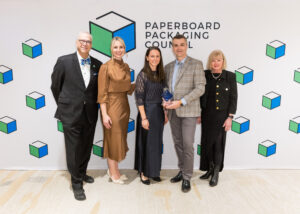
RRD Packaging Solutions took Package of the Year with the Quip Rev Toothbrush, a masterclass in minimalist, plastic-free design. JohnsByrne earned Folding Carton of the Year for its dramatic Goose Island Bardstown carton, while TPC Printing & Packaging captured Rigid Box of the Year with Bacardi’s MTV Video Awards collector box.
Innovation shone through in Oliver Inc.’s “Ugly Duck” paperboard wine bottle, and Smurfit Westrock secured Sustainability of the Year for Bio-Techne’s fully recyclable retainer kit. Judges also recognized standout work from JohnsByrne, Oliver Inc., and Graphic Packaging International, whose ingenuity in structure, converting, and design showcased the best of what paperboard can achieve.
Honoring Legacy and Leadership: The Woods Scholar Award
This year’s Woods Scholar Award carried special significance as PPC formally renamed the honor to recognize both J. Edward Woods and his recently passed son, Doug Woods, of Dixie Pulp & Paper, two leaders whose commitment to education and industry development shaped PPC for decades. Established by the Woods family, the award celebrates rising talent in the folding carton industry and provides each recipient with a full scholarship to PPC’s Folding Carton Boot Camp, continuing Ed’s legacy of hands-on learning.
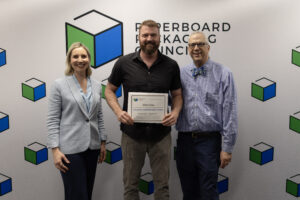
The 2025 Woods Scholar, Chris Cox of Malnove, exemplifies the curiosity, dedication, and promise that both Ed and Doug championed. In a year centered on unity and transition, honoring the Woods legacy, and uplifting the next generation, felt especially resonant.
Sponsor Acknowledgment: Partners in Progress
PPC’s Fall Meeting was made possible through the partnership of sponsors who continue investing in the growth, education, and connection of our industry. Their support strengthens PPC’s ability to deliver high-value programming, advocacy, and community-building initiatives. They are essential partners in the unity and forward motion of our membership.
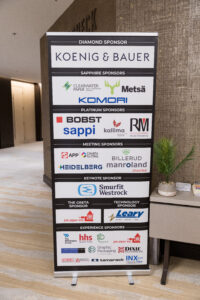
Diamond Sponsor: Koenig & Bauer
Platinum Sponsors: Bobst, RM Machinery, Inc., Kallima Paper, Sappi
Sapphire Sponsors: Clearwater Paper Corp., Komori Corp., and Metsä Board Americas Corporation
Meeting Sponsors: Charta Global / APP, Billerud, Heidelberg, and Manroland
Keynote Speaker Sponsor: Smurfit Westrock
Student Design Challenge Sponsors: Graphic Packaging International, Neff Packaging Solutions, PaperWorks, RRD Packaging Solutions, and Smurfit Westrock
Experience Sponsors: Graphic Packaging International, Dixie Pulp & Paper, Leary Co., W.H., Baumer HHS Corp., Joe Piper Inc., Roosevelt Paper Co., The Wilmington Group, Tamarack, National Fiber Supply Co., and Eukalin Adhesives Specialists.
Thank You: PPC’s Executive Committee & Board of Directors
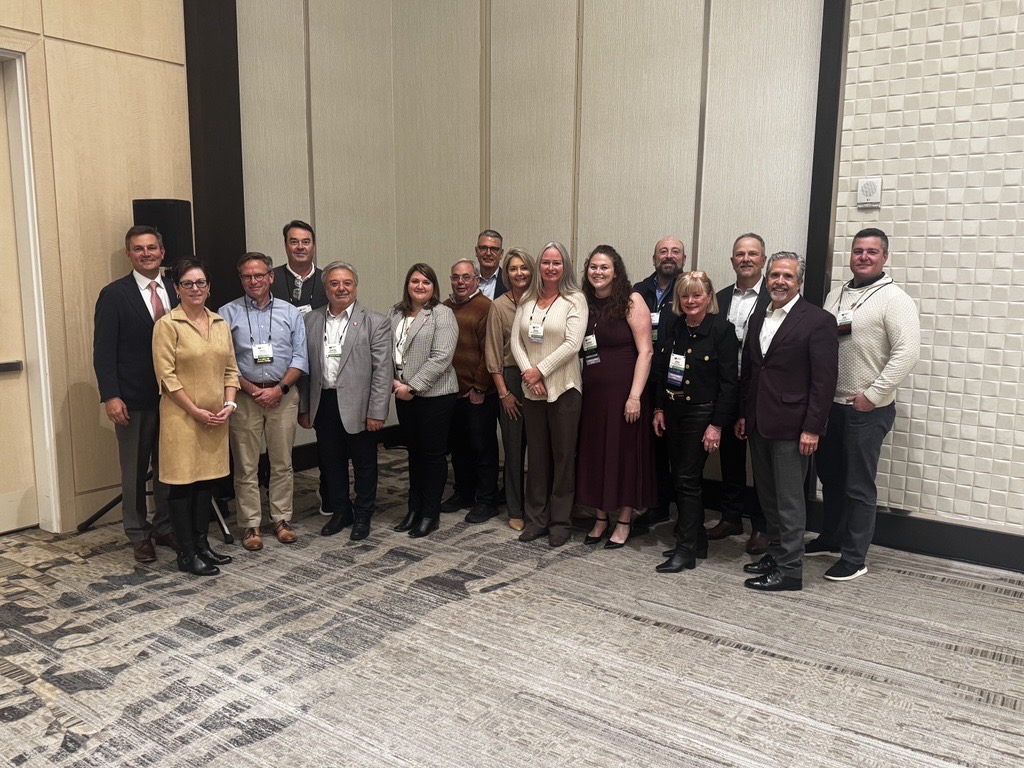
PPC’s strength is rooted in the visionary leadership of our Executive Committee and Board of Directors, whose guidance ensures the association remains focused, forward-looking, and deeply aligned with its mission to advance the paperboard packaging industry.
Their stewardship fosters collaboration, strengthens PPC’s voice, and empowers the organization to anticipate change while championing the needs of converters, suppliers, and the next generation of packaging professionals. We are grateful for their commitment and proud to recognize those who dedicate their time, expertise, and passion to shaping PPC’s future.
Executive Committee
- Hilda Murray, TPC Printing & Packaging — Chair
- Laura Brodie, Pusterla US — Treasurer
- Brian Janki, PaperWorks — Secretary
- Sam Shoemaker, Smurfit Westrock — Member at Large
- Eric Malnove, Malnove Packaging Solutions — Member at Large
- Lisa Pruett, RRD Packaging Solutions — Member at Large
Board of Directors
Tommy Conner – Accord Carton Company
Laura Parlagreco – Astro Box Corporation
Jean-Christophe Duchamp – Autajon Packaging
Joel Zaas – BOXit Corporation
John Lackner – Colbert Packaging Corporation
Kerry Brown – Curtis Packaging
Emma Roehlke – F. M. Howell & Company
Katherine Roehlke – F. M. Howell & Company (Past Chair)
Ken Petty – Indiana Carton Company, Inc.
Sarah Skinner – Ingersoll Paper Box Company Limited
Eric Frank – Koenig & Bauer (US) Inc. (Chair, Associate Members; Chair, Membership)
Robert Feeser – Mill Rock Packaging Holdings, LLC
Robert Neff – Neff Packaging Solutions
Darryl Carlson – Royal Paper Box Company
Brian Hunt – Southern Champion Tray
Roy Hibbs – Southern Champion Tray
David Taylor – Tavo Packaging, Inc.
Madison Keyser – Utah Paper Box Company
Stacy Warneke – Warneke Paper Box Company