What do McDonald’s, Dunkin’ Donuts, and sea turtles have in common? Learn how all three are significantly impacting sustainability in our industry.

We’ve released our biggest publication of the year: the 2019-20 Trends Report. Created by the economists at Fastmarkets RISI exclusively for our members, the report offers economic and consumer forecasts for the folding carton market through 2023.
With over 100 pages of insights, Trends is a huge resource. While we recommend reading it from cover to cover, below are just a few of the top highlights from this year’s report.
Return of Frozen Foods
The frozen food market has struggled for many years as consumers chose healthier, on-the-go food options. However, demand has begun to grow over the past five years, with folding carton shipments to the frozen foods sector rising at an 1.5% average annual rate.
The improving labor market could be at work here: as higher rates of employment impose time restraints on the working population, consumers are again turning to quick, easy frozen foods. Millennials have significantly contributed to the recent rebound in the frozen food market. Younger consumers are waiting longer to form families, and many do not have the time to make fresh meals on a daily basis. Frozen, single-serving foods are therefore an appealing option. Prospects for frozen food carton shipments are expected to grow at 1.2% per annum over the next five years.
Sustainability Wins in Retail Carry-Out
According to Trends, retail carry-out represents a promising market for folding cartons as the environmental impacts of packaging have been brought to the spotlight. For example, a video of a sea turtle with a four-inch straw in its nostril recently went viral, shedding light on plastic’s non-biodegradable nature and its long-term impact on the environment.
As the war on plastics heats up, there is strong potential that folding cartons will gain a greater share in the retail carry-out market. McDonald’s plans to use renewable, recycled, or certified sources for all packaging by 2025. Dunkin’ Donuts started eliminating polystyrene foam cups from its global supply chain in the spring of 2018, with a 2020 target date of completion. The foam cups are being replaced with double-walled paper cups. This step falls in line with the company’s commitments in the U.S. to have 80% of fiber-based packaging certified by Sustainable Forestry Initiative Standard by the end of 2018. Fastmarkets RISI forecasts folding carton shipments to retail carry-out will grow by 1.7% between 2019 and 2023, making it the fastest growing segment over the horizon.
E-Commerce Blues
E-commerce is a growing force in the dry foods and household supplies sectors. The emerging digital retail model has gained momentum with the acquisition of Whole Foods Market by Amazon. Additionally, consumers are turning to e-commerce for their home tools and appliances. The convenience of online shopping, competitive prices, and the variety of options have all enhanced e-commerce sales.
Unfortunately, the rise of e-commerce may not benefit the folding carton industry. E-commerce sales in the cereal and household supplies markets will limit the growth of folding carton shipments in these sectors, allowing corrugated boxes to gain share in the long run. Carton shipments to these sectors will likely contract over the next five years as packaging demands shift toward the needs of e-commerce rather than store shelves.
Growing Markets, Declining Markets
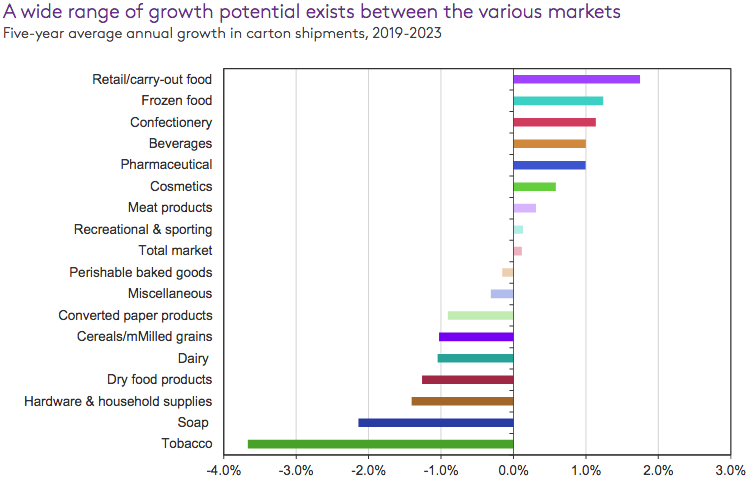
In addition to an overall folding carton market forecast, the Trends Report offers insights into 17 end-use market categories. These can be grouped into three classifications: growing, mature, and declining. Growth markets are classified by average annual growth of 1.0% or more. According to the report, five end-use markets are poised to grow by more than 1% a year: retail carry-out, frozen food, confectionery, beverages, and pharmaceuticals.
The mature, or stagnant, markets can expect virtually no growth in tonnage shipments during the next five years, with growth rates that range from just under a 1.0% average annual increase to just under a 1.0% annual decline. There are six mature markets this year: cosmetics, meat products, recreational & sporting goods, perishable baked goods, miscellaneous, and converted paper products.
Six market segments are classified as declining: cereals & milled grains, dairy, dry food products, hardware & household supplies, soap, and tobacco. The average annual decline forecast for these markets ranges from 1.0% to 3.7%. Such segments face significant challenges from shifts in consumer spending patterns, rising imports, and losses in market share.
These insights just scratch the surface of all the 2019-20 Trends Report has to offer! Head to the Member Center to download the full report.