By Erich Murray, TPC Printing & Packaging
 Without question, success in the paperboard packaging industry is increasingly contingent on innovation.
As box makers, our clients are no longer interested in the design that was successful last year, or even last month. No, their focus lies firmly on the horizon and with the newest new, the biggest ‘wow’ factor, and the next enhancement that will differentiate their product.
And who can blame them?
With product SKUs multiplying at a hyper speed, the cost of retail display at an all-time high, and let’s not forget the Amazon factor – which today’s brand manager can all but ignore, who can fault the packaging designer for an intense obsession with innovative solutions?
We certainly can’t. Better to accept that within this challenging environment also exists opportunity. And to unlock the opportunity, the first question that we must ask is, do we want to be the solution providers, or not?
And I believe that being members of the PPC means we’ve already answered this question resoundingly…
Yes, we do.
But simply delivering a one-time packaging solution isn’t enough. Far from it. Our customers want a partner that will continuously deliver. Before we can do that, however, we must ensure that our organizations are functioning in a way that truly embraces innovation.
How do we foster a culture of innovation within our organizations?
This fall, I was honored to lead the PPC’s New Generation Leaders (NGL) group session at the Fall Meeting in Minneapolis, and I decided to focus on this topic. After all, if we’re going to deliver innovation to our customers, then it must be something our teams live and breathe every day. Here are a few highlights from our session:
Change is Imminent
Innovation cannot exist without change. Moreover, building an innovative culture means creating one that is willing to change. Innovation doesn’t come with sitting still either, and the price of doing so can be significant. As former General Electric CEO Jack Welch reminds us, “When change in the environment is faster than the change inside your company, the end is in sight.”
So really, it’s not only a matter of client retention and business development that we embrace a culture of innovation and change, it’s a matter of survival.
And if that isn’t candid enough…
“It is not necessary to change. Survival is not mandatory”. – W Edwards Deming
It’s Not the Paperboard, It’s the People
Managing innovation across our organizations means leading change initiatives through our teams. And as leaders, I would argue that change management is the toughest challenge we will face. Change is a people problem, and therefore so is innovation.
Let’s face it, the machines that create our products could care less about change. They embrace change the moment we tell them to. The machine is 100% on board as soon as a person presses the start button.
Our people are not so easily influenced. By our nature, humans resist change. And we can therefore become complacent, simply due to fear of the unknown.
Furthermore, organizational complacency is a natural tendency of many successful companies. It is in this form of complacency that a sense of organizational security exists while operating at the status quo. It exists, because, “this always worked for us in the past, and it’s working now.” But this misguided pleasure with sitting still is dangerous. I’d be willing to bet that senior leaders at Blockbuster, Kodak, Pan Am, or Toys R Us (the list goes on) were VERY comfortable operating within the status quo…until they weren’t.
If we’re going to be the innovative solution provider for our customers, managing change must be a paramount focus. Complacency is the greatest enemy of innovation, and as leaders, we need to snuff it out. Until the comfort with “the way we’ve always done it” is extinguished, we will never become the partner/provider our customers truly desire.
So, how do we successfully manage change?
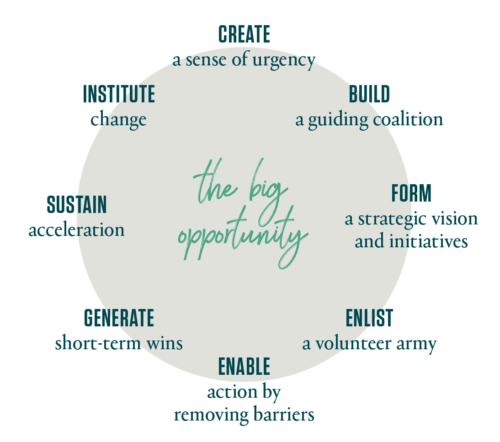 Personally, I’m a big fan of Dr. John Kotter’s 8-Step Process for Leading Change. The first step is to create a sense of urgency on the team. In other words, saying “here’s what we need to do, and here’s why we need to do it.” During the NGL discussion, we shared past experiences, including failures, with change management. In doing so, we unearthed a common, recurring theme that resulted in failure. In the face of leading change, many leaders will skip directly to implementing it.
Kotter’s first step reminds us that, in order to truly sustain a change, we must begin at the beginning. Prior to implementation, we should educate about the “why”— that is, why the change is critical to our success.
Weaving innovation into the fabric of our company culture requires constant change management, and as leaders we can never overlook the key to sustaining change, the people.
It’s an Investment
According to Accenture, “57% of organizations experience a decline in productivity during change management initiatives.”
That’s right. Investing in change comes with a price.
Any form of change to the way we do business will require time, energy, and let’s not overlook – a financial commitment. While our customer service department, for example, learns to navigate a new communication platform, their productivity will undoubtedly fall. And while we install a new production machine, our throughput will dip.
But this is the nature of change. It’s an investment.
Additionally, if we’re committed to becoming the innovative solution provider for our customers, we shouldn’t be waiting to react to their needs. On the contrary, we should lead them to the next solution. Otherwise, we’re sitting back and awaiting their design guidance at the next product launch. Our NGL group agreed. We should be “out front” as our group coined it, not chasing behind.
Staying out front and leading the innovative process clearly means investing in it. And that means we will lose some productivity along the way. It’s better to accept this fact now, plan accordingly, and remain focused on the long-term benefit—being our customer’s solution.
The Challenge is Enduring
Being an innovative solution provider isn’t a short-term gig. We can’t innovate for a period and then return to the status quo. We have to challenge ourselves every day. In doing so, innovation will remain at the forefront of our company’s culture.
Furthermore, the only way to sustain a culture of innovation and change is to lead it every day. Leaders cannot unplug after producing short-term results. Maintaining this culture requires constant engagement and reinforcement.
We must also understand that championing innovation within our organizations will not always be easy. It may be easier when things are going right and we’re seeing the results, but when our business is challenged and results are scarce, it will be hard. This is when we will be challenged the most.
Latin writer, Publilius Syrus, writes, “Anyone can steer the ship when the seas are calm.” We must remember that leading innovation will come with good times and bad. During the bad times, when it seems like what we’re doing is downright crazy, and the team begins to question the journey, our job is to lead even harder. It’s our job to maintain the course, while maintaining sight of the long-term benefit.
In the end, emerging from the storm on the other side is what will set us apart. It will differentiate us from the competition, and it will embolden our innovative culture into the future.
What are your perspectives on leadership in the paperboard packaging industry? Together we can share your ideas and grow our businesses. I encourage you to reach out to PPC and submit your own article.